Media Advisory
June 9th 2026
Contact Yael Shafritz yael.shafritz@jufj.org 808-724-5758 and Elizabeth Falcon elizabeth@dcjwj.org 202-674-2872
Despite some Council restorations, DC is about to be the only jurisdiction to reduce paid family and medical leave benefits after they have been implemented.
Raiding of the Universal Paid Leave Fund to pay for other District priorities remains a problem in this budget, leaving racial inequities unaddressed
When the FY27 budget was first introduced, Mayor Bowser made sweeping cuts to the Paid Family Leave Program. Thanks to the work of the DC Paid Leave Coalition and the Council, the budget introduced by Chairman Mendelson makes major restorations to paid leave. The DC Paid Leave Coalition wants to thank the Chairman and the many councilmembers, particularly Councilmembers R. White, Allen, Nadeau, Lewis - George and Crawford, who prioritized the issue of the Paid Family and Medical Leave program in budget priorities. Through their actions, DC workers will still be able to access some time to care for themselves or their family members in the case of a serious medical issue.
Unfortunately, the Chairman’s budget still makes cuts to medical and family caregiving leave and reduces the maximum benefit amount. As a result, the racial inequities in the program’s cuts still remain. Additionally, the raiding of the Universal Paid Leave Fund to pay for other District priorities remains a problem in this budget.
Chairman Mendelson refuses to commit to ongoing revenue strategies like a simple wealth tax or business activity tax to close the gap in DC’s budget. Without structural changes like this, low-income workers and small businesses will bear the brunt of the budget cuts while DC residents who are already benefiting from the Trump tax cuts are not being asked to contribute.
The cuts as they stand
Currently the Paid Leave program provides 12 weeks of Family Caregiving Leave Benefit every 52 weeks. The Mayor completely eliminated Family Caregiving Leave for FY27 and reduced it to 6 weeks in the outyears; the Chairman’s budget reduces it to 6 weeks for FY27 rather than eliminating it altogether and is the same as the Mayor’s proposal in the out years.
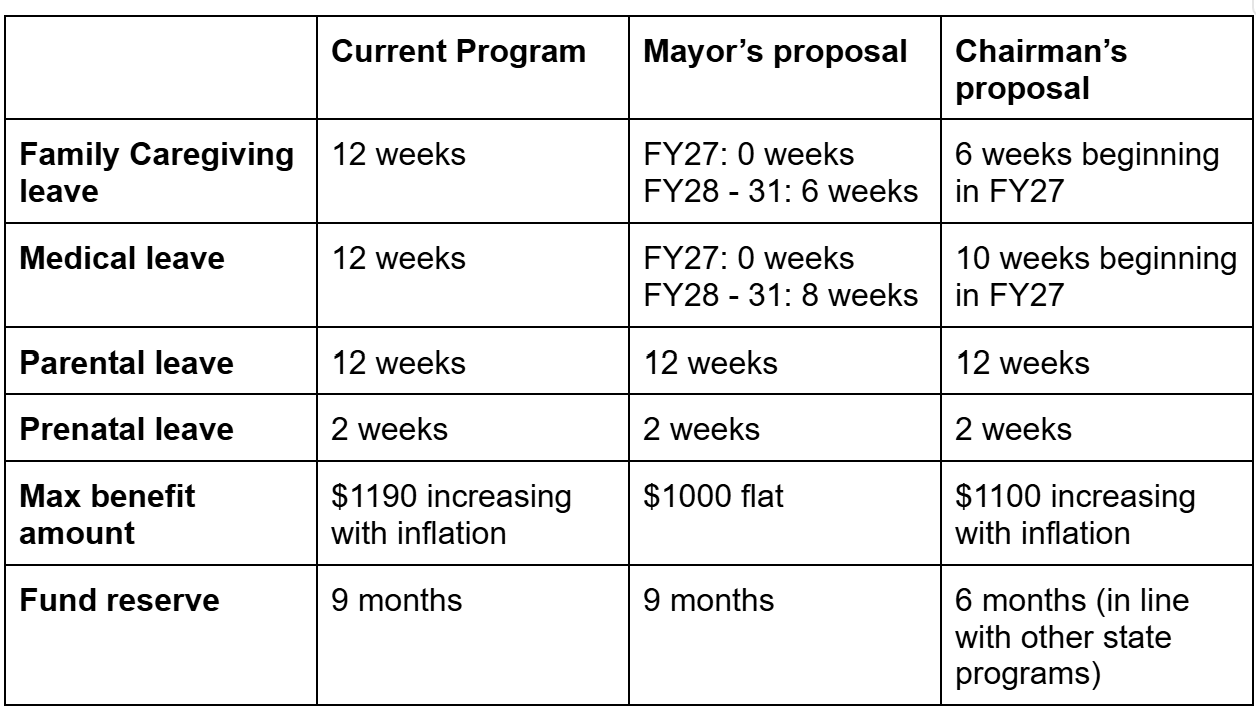
Currently the Paid Leave program provides 12 weeks of Medical Leave Benefit every 52 weeks.The Mayor completely eliminated Medical Leave for FY27 and reduced it to 8 weeks in the outyears; the Chairman’s budget reduces it to 10 weeks for FY27 (rather than eliminating it altogether) and maintains 10 weeks in the outyears, a reduction of 2 weeks from current levels.
The program currently provides 12 weeks of parental leave and 2 weeks of prenatal leave. The Mayor did not touch Parental or Prenatal Leave and the Chairman’s budget has not touched Parental or Prenatal Leave.
The current maximum weekly benefit is $1190 and rises with inflation each year. The Mayor reduced the maximum weekly benefit to $1000 without an annual inflation increase; the Chairman’s budget reduces it to $1100 but keeps the annual inflationary increase.
In the Chairman’s budget, the paid leave fund reserves are lowered from 9 months to 6 months, bringing DC in line with other paid leave funds around the country.
Racial Equity Impact: While the chairman’s budget is an improvement from the Mayor’s budget it still has big gaps. Data from the Department of Employment Services shows that 53% of workers taking family caregiving and medical leave are Black, while less than 25 percent are white. A larger percentage of family caregiving and medical leave claimants also have lower incomes, while a larger percentage of parental leave claimants have higher incomes.
Harming DC Employers and Businesses: The proposed cuts from the Mayor and Chairman both sweep an overwhelming majority of the paid leave tax into the general fund and reduces the amount of the tax going to the paid leave program from 0.25% to 0.11%, this means that while employers and businesses are paying the same level of paid leave tax, they are seeing a reduction in a benefit that they are still paying for. Many DC employers top up the benefits from the program to make their employees’ wages whole. Reducing the maximum weekly benefit will hurt good employers and create economic instability for small and medium employers who have planned for the current benefit levels.
Making DC less competitive with Maryland, Virginia and other States with Paid Leave Programs: The program cuts to Paid Leave put DC at an economic disadvantage compared to Maryland and Virginia. Maryland is about to introduce a stronger program than DC, while Virginia has just passed their program which, when implemented, will also be stronger. DC is the only place in the country to have introduced a successful Paid Leave program and then rolled back the benefits. These cuts will lead to DC becoming a regional and national outlier. At a time when DC needs tax-payers and businesses to stay in the city, these cuts will make the city less attractive.